Wednesday, November 12, 2014

FILM DISTRIBUTION AND CONSUMPTION IN THE DIGITAL AGE


Online Movie Streaming-Netflix  


______________________________________________________________________________

Introduction

Online movie streaming and technological innovations are eradicating the use of DVDs and Blu-rays, movie watching is no longer confined to the living room, as new technological devices do not have the capabilities to view DVDs or Blu-rays. Online movie streaming is a way of watching movies online through movie streaming companies that has emerged with a wide array of Hollywood and alternative movies. Hollywood movies are one of the viable, sustainable entertainment proposition even in today's digital age. They get very large fiscal earnings  from global dispensations, with a wide array of commercial entertainment movie streaming on diverse online platforms through streaming companies. Some of these movie streaming companies are very successful while others are not quite as successful.

The major subscription based movie streaming companies as of second quarter 2014 are Netflix, Amazon and Hulu arranged in chronological order. However the position of Amazon and Hulu are interchangeable in most cases, but Netflix undoubtedly is recognised as the leader in online movie streaming. My focus is on Netflix since they are the market leader in online Hollywood movie streaming with over fifty million subscribers and over  hundreds and thousands of  movies in their repository as of second quarter of 2014.[1]

This topic is relevant to my digital culture and communication program because it reflects on how digitalization, technological innovation and changing spaces or context affects user interaction with content. The moment the movie is moved from the physical space into the virtual space it brings up new cultural practices and challenges.

These challenges though constitutes a practical dilemma to those who deal with the older media, they are still a herculean problem, because a transition from a DVD kiosk into a virtual streaming company is not a very viable business, as resources and materials required are mostly beyond the reach of the ordinary DVD kiosk and also the quantity and quality of movies it can engage with in its repository in order to fulfill customer requirements are very high. There are also much tougher legalities associated with having movies in the virtual space than in the physical space. For instance  movies online has protections that the streaming company offers, the consumer watches the movie online and does not own a copy personally so any defect that allows for a consumer to own a copy of the movie is considered illegal and the streaming company is held responsible for it. Whiles in the DVD kiosk such burdens does not exist, the consumer buys and owns the movies relieving the DVD kiosk of any illegal action that might arise from the consumer.

Considering a company like Netflix, they have DVD rentals online alongside the streaming services, so for such companies transition from older media into the newer media form will be quite smooth because they are already working within the virtual space so there might not even be any losses in that regard. There are greater chances that monetization from the DVD will easily be transferred to the online streaming services.[2] However some are left with no choice but to change their entire business due to the fact that the shift in media is rendering the older media to be unattractive and difficult to negotiate business wise.

Background History of Movie Streaming (Literature Overview) 

The first online VoD platform was Ifilm and was launched in 1997. Online distribution pioneers like Ifilm, Atom films, Entertainers disappeared as the market was not ready for their innovation at the time. Then came the second wave  comprising of  major Hollywood companies like Movielink (originally branded MovieFly), a joint-venture between Sony, Paramount, Universal and Moviebeam (Disney) joining in on the movie streaming services, but they also failed.

These earlier distribution channels didn't make it on the markets because the market was not quite ready for it due to high bandwidth usage which makes it not so affordable and also the newness of the technology and service is something consumers were not acquainted with. The masses were not ready for that transition. However they brought about popularity in the movie streaming services, which in a way helped the third wave to be successful. Online streaming is back in service with varying high demand  on the movie market. Online streaming gives the affordance for movies to be sold directly to individual consumers, it’s ubiquitous connectivity is undermining the traditional distribution companies and has completely revolutionized the DVD and Blu-ray markets as they are on the downward trend  and struggling to keep their heads above water. Sales of DVD and Blu-ray is expected to dwindle further down by 38% within the next four years.

The change in movie watching medium is quite evolutionary to the movie industry in general. Not only are streaming movies online affordable, the level  of comfort it gives the consumer is quite phenomenal. The third wave of online players set in, that is Netflix, Amazon, Hulu, and Itunes.1 They are the market players today with Netflix being the market leader followed by Amazon and Hulu, in that order.[3] There are other numerous ones that have crawled in afterwards like Viaplay among others.

Distributions

Consumer freedom is key to emerging dynamics of online distribution in the digital arena, no wonder other distribution channels are slowly dying off.  Proximity is closely linked to consumer freedom being when, where, quality, quantity and affordability conglomerates.  These are the five factors that are behind Netflix great success in dominating the market. Unlike their competitors such as Amazon and Hulu who have fail to have all these five factors in its entirety. Hulu for example does not have an extensive movie library as compared to Netflix however the quality of content is as good as Netflix. Hulu also does not allow account sharing up to five person like Netflix does. Amazon on the other hand has tons of titles that are included in a search though they are not for free  which frustrates consumers.

Trans device streaming are making online movie watching even more simplistic and handy for both consumers and streaming companies as well. As mentioned by  Stuart Cunningham & Jon Silver- Palgrave(2013) in their Screen Distribution and the New King Kong of the Online World, “The proposition that we are in the middle of a rapid process of change which is seeing established or “old” media being challenged for primacy in audiences’ and users’ attention by new modes and types of production, dissemination and display.” Hence the change is so rapid as companies are charged to alter their structures rapidly in order to go with the flow of current market trends.

What Make Netflix the Market Giant 

Netflix is said to offer an “à la carte” service to its customers as in comparison to its competitors. Netflix is the winning company in on demand online streaming as of today, they deliver niche content to multiple audiences through multiple screens. A users account can be used on television, computer, and even on mobile devices. By not restricting consumer mobility, location or devices, Netflix business model keeps the consumers interest very high. “The power and profitability in screen industries have always resided in distribution”- Jonathan Knee (2011). The success of Netflix resides in its distributions trans devices which is linked closely to the flexibility offered to consumers, and makes the various levels of distribution key to consumer satisfaction. Netflix content also keeps the consumers eyeball on them because it has a fairly well balanced content, with a huge repository  ranging from new releases to old time classics. Netflix strategically offers even more consumer satisfaction by introducing the creation of a profile. The profile page allows up to five members of a household to have their own personalized Netflix experiences within a single Netflix account. Each profile allows for its own: Personalized movie and TV show suggestions, recently watched list, ratings and reviews, taste preferences, my list” It is a more holistic approach, it explicitly allows for more flexibility and reduces the chances of illegal streaming within Netflix platform. Inasmuch as the content plays a major role, the distribution and its innovativeness goes hand in hand with it. In order for Netflix to stand out from the crowd, the quality of content and number of titles on its shelves played a major role. Lately there are trends of interest in alternative movies like the  Bollywood movies[4] and even Swedish movies, for example "The Girl with the Dragon Tattoo" The demand for such movies are also growing quite tremendously.[5] It is no news that Hollywood movies are the kings when it comes to movies and the making and breaking of a streaming company is largely based on Hollywood movies globally. Though there are limited number of scholarly studies of Hollywood digital distribution because most tend to emphasise predominantly on production rather than distributions-Parren and Petruka (2012). Deciphering which services is the best among the major movie streaming companies is no task at all, it is quite clear Netflix have it all right, right timing, right content and right channels. Though affordability is becoming problematic due to a $1 increase in subscription fees during the course of this research.[6] However its quite natural to experience such downturn at the time of the increment more so, the amount involved is not substantial. Subscriptions are expected to bounce back to normal in due course. “Reference to industry history indicates that, like all large-scale corporations, they are likely to use market power to seek to limit competition and corral users inside walled gardens.”- Stuart Cunningham & Jon Silver- Palgrave(2013). Being the market leader in movie streaming they are already aware of how consumers will react, but it is a tactic on their part because they know the commotion will cool off in due cause.  The increment also was very minimal it is a strategy to keep the consumers very close even if they are not happy with the increment they will still stay and not leave because of such insignificant amount thereby keeping the consumers in a walled garden.

Conclusion

As the world progresses steadily in the digital age, even reluctant digital immigrants (Persons born or brought up before the wide spread of digital technologies) are slowly but steadily joining in on the  digital arena. Thus in the nearer future, DVDs will completely be in the past even in places where digital divide (being the gap between those with internet access and those without) is a formidable problem because more and more third world countries are putting in extreme measures to minimize or obliterate the digital divide in its entirety.[7] Not only the developing countries but also developed countries like the USA still have issues of digital divide though in that context it is mostly linked to the reluctance of the digital immigrant  to join in on the digital arena (Technophobia) and sometimes also linked to issue of poverty.[8] Just like the video cassette vanished from the system so will the Blu-rays and DVDs because movie watching in today's terms is not an activity confined to a living room, most of our electronic devices like the Smartphones, Tablets and even the Laptops do not have DVD players. Online movie streaming is the future, its going to be bigger and better because it addresses almost all the needs of the consumer. It is flexible, it is cost effective and also have a wide array of movies to choose from, all at the comfort of one's own location of choice. There is also a greater desire for movies by consumers today as they get to stream countless amount of movies on trans devices regardless of location or time. This is paving way for consumers to develop taste for other movies other than the Hollywood productions. The trend is opening up greater opportunities in the movie industry that will help smaller and unpopular movie industries to also get a share of the fame of the movie industry. For Hollywood being the King in the movie industry, is going to be for quite a while but they would have to let go of a much larger portion of  the market share  than they have now, for the emerging taste of the new digital consumer. As recognised by Stuart Cunningham & Jon Silver- Palgrave(2013)“When it comes to the sale or rental of film and television programming to online audiences, Hollywood content, as the saying famously goes, has been king. There was, until recently, little evidence of a critical mass of online viewers willing to pay for alternative fare” this shows a showing a trend in emerging taste of online viewer, and will opened up opportunities for alternative movies in a broader spectrum.  
  
References

Screen Distribution and the New King Kong of the Online World:(2013) Stuart Cunningham & Jon Silver- Palgrave Macmillan

Remaking the Movies:(2008) Digital Content and the Evolution of the Film and Video Industries-OECD

Netflix global streaming domination

Swedish Institute-Swedish film in summary- Retrieved 2012-10-23

Netflix dominate rivals

Growing demand for Bollywood movies

Demand for Swedish films

Netflix subscription price increase

7.http://www.un.org/press/en/2013/gaef3374.doc.htm

Digital Divide in the US


LIFE OF THE AFRICAN STUDENT IN SWEDEN


A short documentary about how the African student finds Sweden. What are the interesting things in Sweden? the food, the people, the culture and What are the basic requirements as a foreigner in Sweden. These are told from the perspective of the African living in Sweden. I was inspired to do this documentary out of curiosity about a lot of things in Sweden which I didn't find easy answers to instantly. Though these are basic norms and everyday things for anyone living in Sweden, It may be quite foreign to anyone living outside Scandinavia. Had I known all these basic information before or just after coming to Sweden I would have done a lot of things differently. I think this documentary could benefit people aspiring to come to Sweden. I wish to do a follow up documentary on other aspects that were not captured in this part very soon.  Enjoy and share your comments.


Saturday, October 4, 2014

INTERCULTURAL COMMUNICATION

Summary 

Aspects of Xenophobe's Guide


The Canadians
Canadians have a sense of decency, honesty, integrity in the sense that a good reputation and virtuous character are principal features of a Canadian society. They have a high level of tolerance that can become a weakness, their lives are about peace and order. Trust in politicians or good governance are not credible enough.  They naturally do not like being mistaken for Americans however they are very easy going and their life worth is mostly portrayed in travels. They link well being, happiness and their wealth to how often they travel.  They are extremely fond of nature and natural reserves and also prefer spacious homes. They do not brag neither are they arrogant, they spend their wealth on intangibles. They allow for religious freedom, marriage is not  a necessity in the broader sense hence there is a low reproduction rate.


The Aussies
Aussies are believers in their own individuality and are keen on non conformity. There is a clear division in suburbs diving the old and the young. Aussies desire to pursue pleasure which is mainly to surf,  in between which they have drink, eat, sleep, love, and work, these leisure time sometimes can compromise work but its still ok.  This is one idiosyncratic characteristic of all Aussie and they hold it dear.   Classism among Aussies is mostly based on character except in the more affluent areas. They spend what they have without being penny-pinch about it. They prioritise on how one's wealth is made in order to give credibility, hence a typical Aussie have no trust for entrepreneurs they  are perceived as crooks and dishonest people though their spending power makes them powerful. The right way to acquire huge money is by winning it. Aussies take pride in the display of tangible assets in an extravagant way in the exterior of their yard to be seen by all while the inside get a perfunctory attention.


The English
The English relates any attitude to common sense whilst in actual fact the common sense mean forethinking or planning in anticipation, this also shows inventiveness and handiness of the english. To have a sense of englishness is to be enduring of uncomfortable situations with calm  and without complains, thats why the english suspect that all foreigners tend to overreact and make big issue out of nothing.  The english are lovers of sports, and yearns for a sense of belongingness hence reason for so many english clubs and society.To the english its better to be a part of a team even if it’s without any greater purpose. The focus is on the association and the togetherness or sociality. They are not deeply religious, hence they do not believe in soul searching  which makes them least introspective of other races. Class is an important aspect of the english society, accents can easily be used to place individuals in the english society.


The Americans
The American is flamboyant filled with pride and hold money in high esteem. An american without work is a nobody and living the American  dream entails  showing off wealth in the  form of automobile along with house and a garden. The kind of car reflects the owners personality and social status. They have high interest in the use of gadgets, manually doing things are almost forbidden, hence the use of gadgets also ties into the social status.  They have a phobia for growing old and looking fat but then 15 million Americans are morbidly obese. the family is nuclear, children are raised to be independent but cautious. The best years of most americans lives is their teenage years due to low responsibilities and lots of spendable income.  The American is opened about sex and frowns on adultery publicly.


Work Cited


Miall Antony & Milsted David. The Xenophobe’s Guide to The English (Oval Books, 2008)
RosteVaughn . The Xenophobe’s Guide to The Canadians (Oval Books, 2002)
Hunt Ken & Taylor Mike. The Xenophobe’s Guide to The Aussies (Oval Books, 2004)


Faul Stephanie. The Xenophobe’s Guide to The Americans (Oval Books, 1999)

Wednesday, February 19, 2014

African Oil

Political ramifications of Ghana oil finds.  


http://www.svtplay.se/video/1821387?type=embed

Friday, August 2, 2013

Invitational Rhetoric


Multimodal Writing

 “Beyond Persuasion” a text by Sonja K. Foss and Cindy L. Griffin. An analyses of  the concepts of invitational rhetoric. Reading Beyond persuasion has given me a better insight on invitational rhetoric and I find it very intriguing. Though to me this style or approach of communication has been in existence for quite a while but basically on the masses level not in the formal or academic circles. People use it on daily basis, so I will presume that the feminists are proposing or aiming for it to proliferate into the academic circles by giving it a better structure.

Invitational rhetoric espouses communication based on understanding perspectives and thinking through each other’s point of view with no aim to persuade but rather communicate on neutral and non-hierarchical grounds. The relationship between the rhetor or speaker and the audience is an equal one that allows for the rhetor to meet the audience at whatever level they might be on and learn about the complexities of issues from each other’s perspective. It is an alternative way of communicating as in contrast with theories that posit persuasion as the goal of communication like the traditional rhetoric with its main purpose of communication being to effect change.

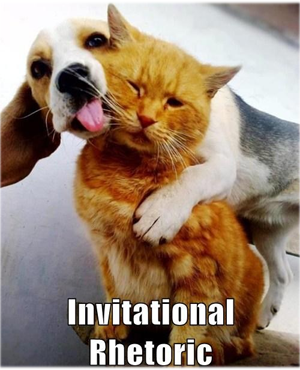
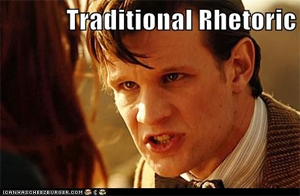
ir1 TR

Memes of both traditional and invitational rhetorics
Another thing I deduced based on my reading is that invitational rhetoric denounces the use of force or persuasion to alter perspectives. Rather it says; This is my point of view, show me yours and lets discuss through, I will think through your point of view with the aim of understanding you better and enlightening myself if necessary, you may also do same. If in the process of discussion change is attained, fine if not that is also fine because it posit dialogue as ethically superior, so with the mere beginning of dialogue its purpose is partially attained.

People want to have the flexibility of making decisions without been forced, so for me this style of communication is legitimate, you communicate about an issue without only looking at its merits and demerits but rather you deal with the issue on a broader spectrum  and analyse complexities that comes with it.  Through these complexities, other angles of ideas and options are generated which gives justification to the topic that is being explored.

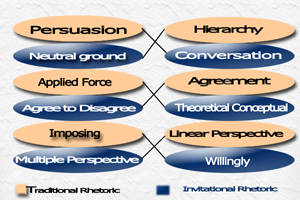
IR-ps

These are some of the basic principles of traditional and invitational rhetorics.
The invitational rhetoric style of communication of course comes with its strengths and weaknesses, for instance how do you get a point of views across without being overly conversational. It can be quite difficult to put your claim across or even for the audience to better understand your standpoint on the issue.  I found this YouTube video that I think rightly represents the theories of invitational rhetoric. This movie shows a board room where conversations about the state of affairs of a nation takes place , in their conversations they all had different views and opinions about Cuba launching an air strike on America. I think the grounds and levels of discussions were quite interesting. Enjoy the video and let’s continue the discussion after.

In the video the board members did not argue or use a confrontational approach but rather, they all presented their opinions in a conversational way. Others took in the views of their opponents and gave new perspectives and assumptions based on their point of view.

They also presented their information in a multimodal form with substantial amount of facts to back their claim, they showed images of their opponents’ nuclear weapons and the pace at which the worker over there go about their duties.  They also showed map of US soils that might be in the targeted range in case of an airstrike. The multiple modes of presentation within this video helps to better understand the issues been discussed.

The piece is structured in a way that a specific point of entry is irrelevant, if you didn’t watch the full video and probably just start watching when it’s nearing the end you can still grasp the meanings of what they are trying to say or do because it’s presented in a non-linear way.  They break down their language to meet the needs of those they assume might not be able to digest some vocabulary usage for instance breaking down the conversation that a blockage is tantamount to an act of war. This shows an example of how a rhetor will meet his or her audience at whatever level they might on and have enlightening conversations without barriers.

In the video the man mentioned that “don’t make the aggressor more aggressive” meaning that they have to find a way to have common grounds without necessarily using force. This is totally in line with the invitational rhetoric notion of nonviolence act.   In the end of the conversations one group proposed quarantine measures while the other proposed airstrike measures, however no unanimous decisions were made but preparation were made to favour both scenarios. This video in my opinion is a perfect example of how invitational rhetoric works.

CULTURAL NEW YORK THROUGH MEDIA


Just another view of New York City through the eyes of media...

An interesting video of 

   
In this blog post we are working in pair to create a remix about the city of New York and various cultural phenomenon that are in play. Our main aim is to look at New York in a broader spectrum and highlight on media culture and how media engages us to think about the city and guide us in creating our perspective of the city.
The city of New York is one of the epic centers of modernity with hegemonic ideologies of human progress through social and cultural constructions of how people should think and do things ”natural” through the proliferation of mass media, Increasing role of science and technology, Urbanization, Capitalism, Surveillance, and Consumerism. The city through media has portrayed itself as the greatest city in the world, where almost everything happens, from sky scrapers, great architecture, good businesses, great financial markets, fashion houses, theatres, huge population and a multicultural life experiences.


There is a growing desire from people in other lands and even within the United States to migrate to New York and live in the thick of the urban populace, these desires are modified by popular currents that capitalist society, mass media specialize in formulating and conveys an image of the city as a city that strives for success for its people through various mediums such as advertisements, music lyrics, imagery and business opportunities . Hence the city’s nick name ”The Big Apple” ”City of Dreams” among others. It’s believed that if one can make it in New York, then one can make it anywhere in the world. Base on this ideology the movie titledNew York, New York in which Liza Minnelli sung the song ”New York New York” in 1970s was made. Then the song was re-sung by Frank Sinatra a few years later which made the song even more popular. Through out the transition and remixing of the music, the main theme of the song was kept, conveying the same message as New York being a great city with hopes and dreams that one want to be a part of. Alicia Key also recently re-sung the same Song and kept the theme so that it’s easily recognizable, conveying the same message as predecessor. Passim these times the view of New York as a city of dreams still stand firm. People still have the same perspective of New York as it was in the era of modernity. In today’s society the western culture are still the information society. It is not only through the music that we got a perspective about New York but also through other media forms, information is passed on to other parts of the world that gives a clear linear perspective of how New York should be perceived. It’s an example of how society transcends its hegemonic cultural ideologies on to the masses and creates a narrative that other worlds follow.


There is some sort of media form every where in the city space of New York, from bus terminals to bill boards, everything can be a form of advertisement. New York is one of the biggest cities in the world. They say that New York never sleeps and it is lively even during the night due to neon bill boards and night life. How has New York City changed with the time? New York itself is a kind of remix and consists of many cultures. It has changed from “melting pot” to “salad bowl”. Media play an important role in New York City in terms of public sphere and consumer culture as media advertise in the city. Media events can be simultaneously local, national, and global, they can involve an extraordinary range of producers, sources.
nyny1
Our remix also shows some of the media culture that connects us ”cultural others” to the city of New York and make us feel as if we are culturally inclined to the city. Movies such as “The Godfather” etc are timeless classics that has been watched by various people from different countries which gives them a perspective of the good, bad and historical life of New York city, a series such as “Wall Street Warriers” are also one of a kind that gives us an inside view of what goes on within the cultural setting of a trader’s life and what the pros and cons of trading is like. Though they are just movies and series or TV shows, to a very high degree they are a representation of what the society is like and what one should expect to see in the society.
A view of the city space of New York shows brands and advertisements. It’s interesting to note the social impact of the expansion of mass media from forms such as print and voice (such as black-and-white text-dominated newspapers and radio) into media that combine image, color, movement, text, and sound. These advertisements in city spaces are unavoidable as one is confronted with variations of advertisements from street food to fine restaurants, consumer goods, food chain store, clothing line chains, Businesses, all sort of products and services through various media form such as newspapers, magazines, television, movie theaters, billboards, public transportation systems, website, and in many other contexts in which we may not even notice. These advertisements are in a range of things we need and thing we might never need in the course of our lives. The ideas of these products are sold to us and we buy into the ideologies of the advertisements with the aim of raising our social status, or making ourselves look or feel better or just for buying sake. With such advertisement decorations on city spaces, capitalism is at its, best people tend to buy and buy in the name of being trendy. These are the kind of images and ideologies that media sells to us consciously or unconsciously we buy into them and appropriate our lives to conform to these media cultural ideologies. We are controlled by the media culture that present products to us and the culture is controlled and manipulated by governmental powers. This posses questions such as are we really in control of what we buy? How true are the perspectives that we have on things? Are our ways of reasoning mediated by what we see around us, if so then how can we say we are in control of our own lives?
Its very interesting to know how media culture is  embedded into us, making it blurry to even know when something is one’s own idea, for this reason, I think  the next time we want to buy new Converse sneakers we will think about it deeply and analyze whether or not we are propelled by media.
Works Cited